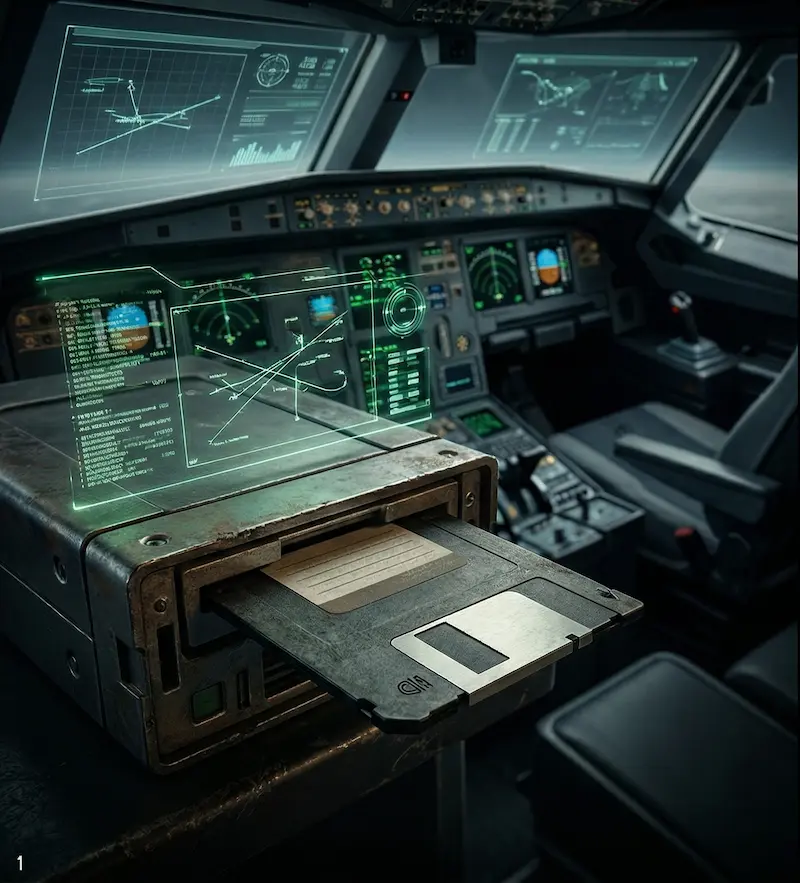
High-Tech with a 30-Year-Old "Brain"
Imagine you bought a modern iPhone, but to update the operating system, you had to plug in a parallel cable from an old dot-matrix printer. Sounds absurd, right? In the consumer world, obsolescence is fast. In the aviation world, time runs on a different scale.
An airplane is designed to fly for 20, 30, or even 40 years. When the Boeing 747-400 was certified, floppy disks were state-of-the-art. The software managing the FMS (Flight Management System) — the onboard computer that guides the aircraft — was written to be extremely lightweight and efficient. It does one single thing: ensure the plane gets from point A to point B safely.
Reliability Over Novelty
In critical systems, the keyword isn't "innovation," but determinism. This means that for every data input, the system must react exactly the same way, every single time.
- Smartphone: If an app crashes, you restart it.
- Aviation: At 33,000 feet, a "crash" is not an option.
Floppy disks are mainly used to load the navigation database (AIRAC cycle), which must be updated every 28 days. Since the file is tiny (mostly text and coordinates), the 1.44 MB of a floppy disk is technically sufficient.
Why Not Just Weld a USB Port?
- The Recertification Abyss: In aviation, you don't just change "one component." Replacing a floppy drive with USB requires manufacturers (Boeing, Airbus) and regulators (FAA, EASA) to perform new electromagnetic interference tests. The cost can range from thousands to millions of dollars per model.
- Attack Surface: A floppy disk is a "dumb" physical medium. It lacks complex firmware that can be infected by modern malware and requires physical access to the cockpit. Wi-Fi or cloud transfers create vulnerabilities that the original hardware was never built to manage.
Other Resilient "Dinosaurs"
- San Francisco Municipal Railway (MUNI): Uses 5.25-inch floppies to load track signaling software.
- Nuclear Missile Silos (USA): Operated for decades using 8-inch floppy disks.
- Nuclear Power Plants: Many critical machines still run on MS-DOS.
The End of an Era
Modern aircraft like the Airbus A350 and the Boeing 787 Dreamliner already use fiber optics and encrypted wireless transfers. However, the legacy remains. Recently, researchers found a 3.5" drive functioning perfectly in a retired 747-400.
The case of these airplanes teaches us that if something is critical, simplicity is your best friend.