The Ghost in the Machine: Why Your Tech is Designed to Die
Have you ever felt like your smartphone, the height of technology just two years ago, has started to "yawn"? The battery no longer holds a charge, updates seem to slow it down, and suddenly, that new-gadget glow has been replaced by constant frustration. You’re not going crazy, and it’s not just "bad luck." You are a key player in a complex economic game called planned obsolescence.
At Trivium, we love connecting the dots between tech and finance. Nothing illustrates this intersection better than the fact that we are induced to spend money on something designed, from birth, to die.
What is Planned Obsolescence, Anyway?
In technical terms, planned obsolescence is the strategy of designing a product with a limited useful life or a design that becomes obsolete after a certain period. It is not a manufacturing defect; it is a design feature.
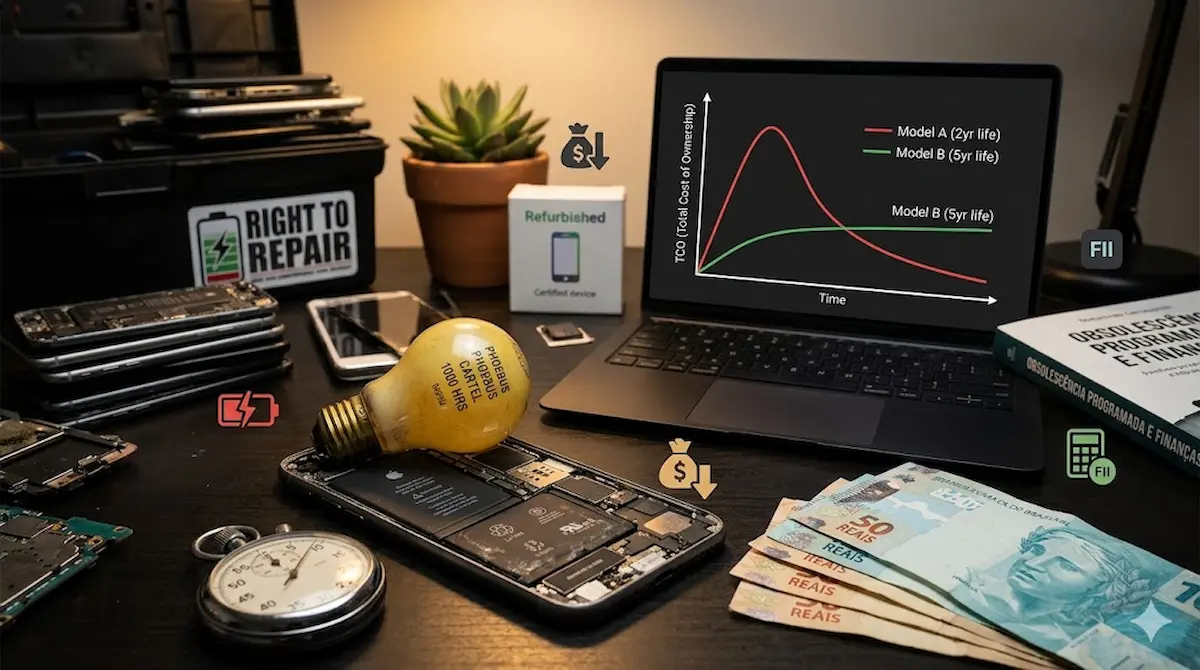
The concept gained traction in the 1920s with the infamous Phoebus Cartel, where lightbulb manufacturers colluded to reduce the life of bulbs from 2,500 hours to just 1,000 hours to force repetitive consumption.
Today, this strategy has evolved into three main types:
- Technical Obsolescence: When a physical component breaks and repair is intentionally expensive (e.g., RAM soldered to the motherboard).
- Software Obsolescence: Common in the mobile world. The hardware works, but the OS becomes too heavy or apps lose compatibility.
- Perceived Obsolescence: When marketing makes you feel "outdated" simply because of a new color or minor aesthetic change.
The Financial Trap: A TCO Analysis
For those seeking financial freedom, obsolescence is a silent capital leak. It increases your TCO (Total Cost of Ownership).
The Math:
- A $400 entry-level phone that lasts 2 years: Cost of $200/year.
- A $900 robust model with 5 years of updates: Cost of $180/year.
In the long run, the money you stop investing in REITs (Real Estate Investment Trusts) or index funds to replace prematurely broken items results in a massive loss of wealth due to compound interest.
The "Right to Repair" and E-waste
The environmental impact is devastating. Most of a phone's value lies in the energy used to manufacture it. When we discard devices prematurely, we fuel mountains of e-waste. The US is one of the world's largest producers of electronic waste, and only a small fraction is processed correctly.
This is why the Right to Repair movement is so vital. It pressures companies to provide manuals, parts, and modular designs. When you buy from brands that facilitate repair, you vote with your wallet.
💡 Trivium Glossary
- TCO: Estimate of a product’s total cost (purchase + maintenance + replacement).
- REITs: Real estate investment funds (US equivalent to FIIs).
- Refurbished: Certified pre-owned devices with warranty and high discounts.
- iFixit: The gold standard for repairability scores.
What was the last device that "died" on you too soon? Do you feel forced to upgrade things that still work?